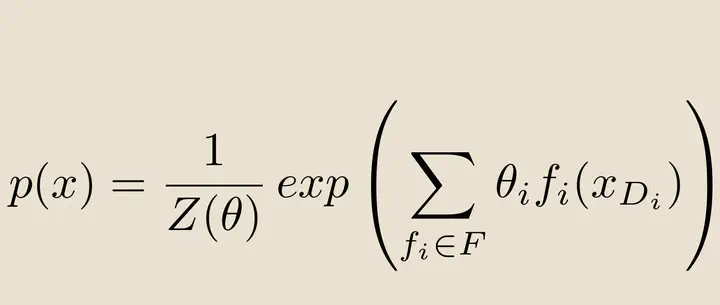
 Log-linear distribution formula
Abstract
Log-linear models are a family of probability distributions which capture a variety of relationships between variables, including context-specific independencies. There are a number of approaches for automatic learning of their independence structures from data, although to date, no efficient method exists for evaluating these approaches directly in terms of their independence structure. The only known methods evaluate them indirectly through the complete density, which requires further learning of the numerical parameters for the structures produced by each approach. These indirect methods introduce potential distortions when used for the comparison of the structures. This work addresses this issue by presenting a measure for the direct and efficient comparison of the independence structures of log-linear models, inspired by the efficient Hamming distance comparison method used in undirected graphical models. The measure presented not only can be efficiently computed in terms of the number of variables of the domain, but is also proven to be a metric. Efficiency with respect to the number of features is not guaranteed for a large number of features in the models and will be the subject of future work.
Links:
- arXiv paper
- Open source implementation in Java, which can also be found at Figshare as ECSLLM: Java Implementation
- Open source implementation of KL-divergence (competitor measure used in examples)
- Shiny app for example of the method

Jan Strappa
ML Researcher | Data Scientist
My interests include Artificial Intelligence & Machine Learning (in particular, metaheuristics & evolutionary computation), parallel and distributed computing, probabilistic models, data mining, deep learning, and NLP.